 Skip to content

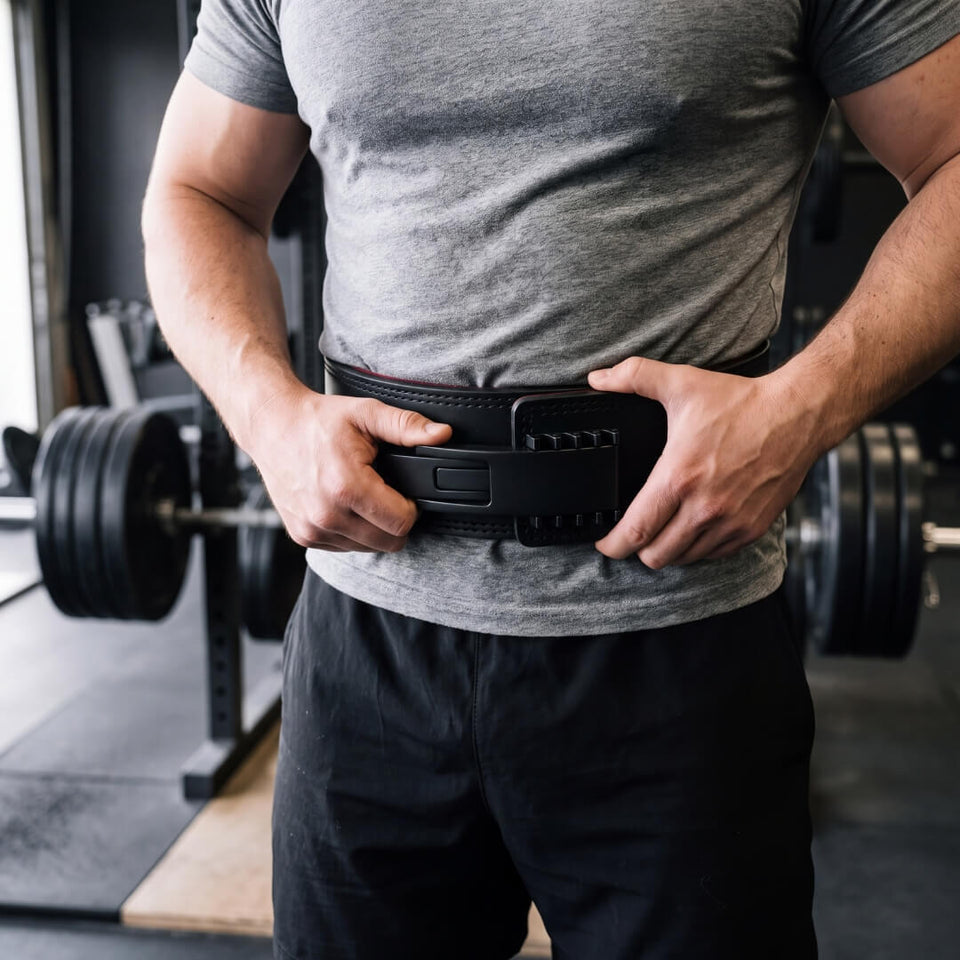
Lever belts differ in how you change the setting. On some, you reset the lever by hand between sets; others are set once with a screwdriver and close at that setting every time. Whichever you have, start with the belt around your navel. A common way to set it is to breathe in, brace, then close the lever. Set right, the belt lets you push your belly hard into it and still take a full breath.
Quick answers
- Wear it around your navel, level all the way round, with the lever at the front.
- Breathe in, brace, then close the lever. Set right, you can still take a full breath and push your belly hard into the belt.
- A toothed plate beside the lever means you change the setting by hand. Our Naga belts have no plate and close at one fixed setting.
- Put it on for your last warm-ups and heavy sets, and open it between sets.
- Belt won't close, pinches or rides up? Jump to the fixes.
Which lever is on your belt?
Close the belt and look at the end of the lever. On most of our belts, a toothed metal plate there means you can change the setting by hand.
| Compare | 5-position | Screwdriver-set |
|---|---|---|
| What you see | On most, a toothed metal plate beside the lever | No toothed plate |
| Between sets | Changed by hand, no tools | Closes at one fixed setting |
| Typical page wording | "Five settings, no screwdriver" | "screwdriver adjust" |
| Our belts | Standard Black, Standard Gray and most of our range | Naga Black and Naga Red |

The settings on a 5‑position belt are the slots in that plate. Our pages call them "pin slots" or "pin settings," and pins on the end of the lever sit in one of them when the belt is closed.
Moving the lever hardware along the strap is a separate job. On a 5‑position belt, leave the screwed-on lever and plate where they are. A screwdriver-set lever's page says to set your size once with a screwdriver. We don't publish detailed instructions for moving between slots, moving the hardware or using that screwdriver, so if you're unsure how yours works, email us before you try. The address is under the fixes.

A lever with no toothed plate isn't necessarily screwdriver-set. Our custom lever belt, for one, has a tool-free gliding lever that is also quick-release and double-pronged. If yours matches neither type, check its product page.
Where should a lever belt sit?
A belt usually sits around your navel, where our sizing guide has you measure. Beyond that starting point, there's no single right height. Guides disagree on whether squats need it higher or lower than deadlifts. Torso length, the hip crease, squat depth and your deadlift start position all change where a belt digs in.
So settle the height in your last warm-up sets. The belt shouldn't jab your ribs at the bottom of a squat or bite into your hip crease as you set up a pull. Wear the lever at the front, where your hands can reach it.
Meets have belt rules too. As of October 2026, the USAPL rulebook (v2026.2) has you wear the belt over your singlet. The USPA rules (March 2025) and IPL rules (2025) let the buckle sit in front or behind you, though not behind you on the bench press. At all three, once you're on the platform, the belt is the only thing you may adjust.
Our lever belts are USAPL & USPA compliant and IPL compliant. On a custom belt, the print also has to meet each federation's rules on logos and wording. We aren't on the IPF Approved List, so our belts aren't for IPF-sanctioned meets.
How tight should a lever belt be?
Fit, tightness and bracing are different things. Fit is your size, which decides whether the lever closes around you at all. Tightness is the setting you close it on, and bracing is the big breath into your belly that you push hard against the belt. Here's one common way to test the setting against your brace, when the belt is new and whenever it feels wrong.
- Put it where you'll wear it. Around your navel, lever at the front, level all the way around.
- Breathe in and brace, as you would for a heavy rep.
- Close the lever. If it won't close while you're braced, don't force it. On a 5‑position lever, try a looser setting. On a screwdriver-set lever, the fixed setting is too tight for your brace; see the fixes.
- Check the brace. You should be able to take a full breath and push your belly hard into the belt without it digging into your ribs or hips.
- Test it in a late warm-up set. If the belt slides, a 5‑position lever can go a setting tighter. Note the setting for each lift.
Finger or hand tests from other guides don't agree with each other. No study we found validates them, so use one only to repeat a setting you've already checked this way.
The studies we did find point to the breath and the brace. In a 2025 study of 28 healthy young men squatting at 75% of their predicted max, deliberate bracing raised abdominal muscle activity with or without a belt. The belt alone didn't change muscle activation, though the published summary doesn't say what kind of belt they wore.
In one modeling study of 9 experienced lifters using light barbell loads, a stiff belt lowered estimated spine compression by about 10% compared with no belt. It did that only when they breathed in before the lift. Neither study tested our belts. Set yours so you can still breathe in and brace into it.
When should you wear it in a session?
Do your first warm-ups without the belt, or with it loose. Put it on at your working setting for the last warm-ups and keep it on for the heavier sets. Open the lever between sets so you can breathe and move freely. The belt gives you something to brace against, but it doesn't brace for you or replace the technique that moves the bar.
We found no study showing that a lifting belt prevents injury. The closest evidence is from workplaces. A 2016 review of prevention trials found that in 3 trials, back belts didn't reduce episodes of low back pain or sick leave compared with groups who didn't wear one.
Those were back supports worn by workers on the job, including stretch nylon belts and elastic lumbar supports. None were lifting belts worn for heavy sets. If you have a condition affected by straining or raised abdominal pressure, check with your doctor before heavy braced lifting.
What if the fit feels wrong?
Find the row that describes what you feel. The cases that need us follow the table.
| Problem | Likely cause | What to try |
|---|---|---|
| Won't close braced | Setting too tight for your brace | On a 5‑position lever, try a looser setting. Don't force it. |
| Pinches ribs or hips | Too high or too low for your torso or depth | Move it slightly and retest in a warm-up |
| Rides up or shifts | Too loose, or not level | Re-seat it level; on a 5‑position lever, a setting tighter |
| Can't change it between sets | Screwdriver-set lever, by design | Use one setting for every lift; if it doesn't suit you, see below |
| Won't close at its loosest, or loose at its tightest | Wrong size for your waist | Don't move any hardware; see below |
| Screw loose or missing | Screws can work loose over time | No heavy sets in it until it's fixed; see below |
Some problems need us rather than a different setting. For a loose or missing screw or a broken lever, stop using the belt for heavy sets and email support@akincistrength.com with your order number and a photo.
A wrong size or a fixed setting that doesn't suit you comes down to the hardware, so email before you unscrew anything. Our belts are final sale and can't be exchanged for size. You can also ask whether our replacement lever, sold for broken or worn lever buckles, fits your belt. Its page says it fits "most 4 inch lever belts using the standard hole pattern."
How do you break it in and look after it?
A new leather belt starts stiff and softens as you train in it, and 13mm takes longer to break in than 10mm. Our belt pages call for no break-in routine, and they describe our suede belts as soft from the first wear. Still choosing a thickness? See our post on choosing between 10mm and 13mm.
For cleaning, follow the care note on your belt's page. Ours call for a damp cloth, or a soft brush for tougher spots, and no soapy water, color-based balms or polishes.
Use leather conditioner only where your note calls for it, and only a small amount. On a printed belt, keep it to the unprinted areas. The care notes on our suede belts don't call for conditioner at all. Most notes also say to air dry the belt away from direct sun and heat and store it somewhere cool and dry. When you clean it, check that none of the lever's screws has worked loose.
Our lifetime warranty covers three failures. If the leather fully tears under normal use, we replace the belt. If the lever breaks, we replace the lever, and if the stitching comes undone, we repair it or replace the belt. It doesn't cover lost screws, cosmetic damage or misuse.
Common questions
Lever belt or prong belt?
A lever opens and closes in one move, so it's quick between sets. A prong belt is adjusted hole by hole. Our prong vs lever guide compares them.
How long does a new lever belt take to break in?
There's no set time. Leather starts stiff and softens as you train in it, and 13mm takes longer than 10mm. Our suede belts start soft from the first wear.
Can I make my lever belt bigger or smaller?
Don't move the hardware yourself. Email support@akincistrength.com first. Our belts are final sale and can't be exchanged for size, so check the sizing guide before you buy.
Can I wear a lever belt at a powerlifting meet?
Our lever belts are USAPL & USPA compliant and IPL compliant. They aren't for IPF-sanctioned meets, because we aren't on the IPF Approved List.
If you're choosing your first lever belt, decide on the lever first. A 5‑position lever lets you loosen the belt for warm-ups and tighten it for top sets. A screwdriver-set lever gives you one fit for every lift.
Ready to pick a belt? Choose one with the lever you want in our lever belt collection and size it with its table on our belt sizing guide.
Sources
- Changes in muscle activation in response to abdominal bracing and stabilization belt use during a loaded squat, Lynch et al., Journal of Sports Sciences, 2025 (bracing and belt use in 28 healthy men squatting at 75% of predicted max)
- Effect of a stiff lifting belt on spine compression during lifting, Kingma et al., Spine, 2006 (a stiff belt, the breath and estimated spine compression)
- Prevention of low back pain: a systematic review and meta-analysis, Steffens et al., JAMA Internal Medicine, 2016 (3 trials of back belts worn by workers, against groups without them; the belt types)
- USA Powerlifting Rulebook, Version 2026.2, USA Powerlifting (belt worn over the singlet; logo rules for belts; the belt as the only adjustment on the platform)
- USPA Technical Rules, March 24, 2025, United States Powerlifting Association (buckle position; belt graphics and costume logo rules; the belt as the only adjustment on the platform)
- IPL Technical Rules, May 10, 2025 (V2), International Powerlifting League (buckle position; belt graphics and costume logo rules; the belt as the only adjustment on the platform)
- Approved list of personal apparel and equipment, 2023 to 2026 (V3), International Powerlifting Federation (Akinci is not listed)
- Lever Belt Collection, Akinci Strength (the lever belts this guide covers)
- Lever belt product pages, including Standard Black, Standard Gray, Naga (Black and Red) and Forge (Black and Red), Akinci Strength (lever, pin-slot, break-in and care wording)
- Homepage thickness panel, Akinci Strength (13mm takes longer to break in than 10mm)
- Modular Adjustable Lever, Akinci Strength (what the replacement lever is for; its fit wording)
- Sizing Guide - WeightLifting Belt, Akinci Strength (where to measure; the size tables)
- Shipping & Returns, Akinci Strength (belts are final sale; no size exchanges; the support address)
- Lifetime Warranty Certificate, Akinci Strength (what the warranty covers and excludes; what a claim needs)
Sources accessed October 12, 2026; Akinci pages, links and rulebooks re-checked October 12, 2026.
