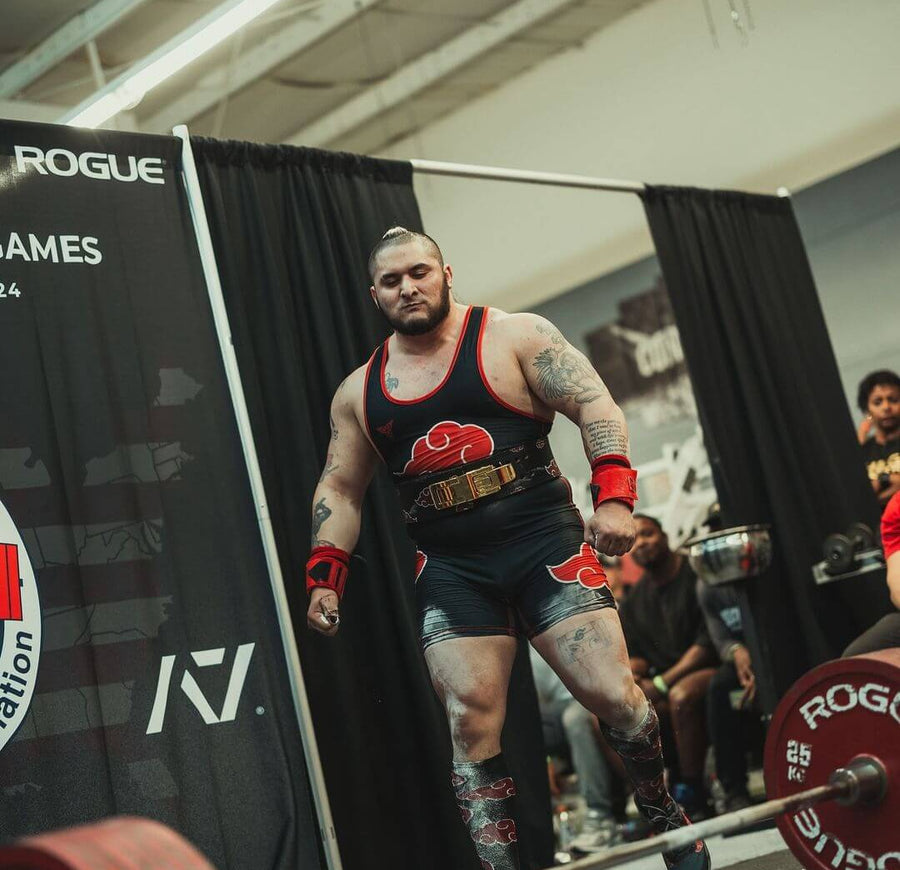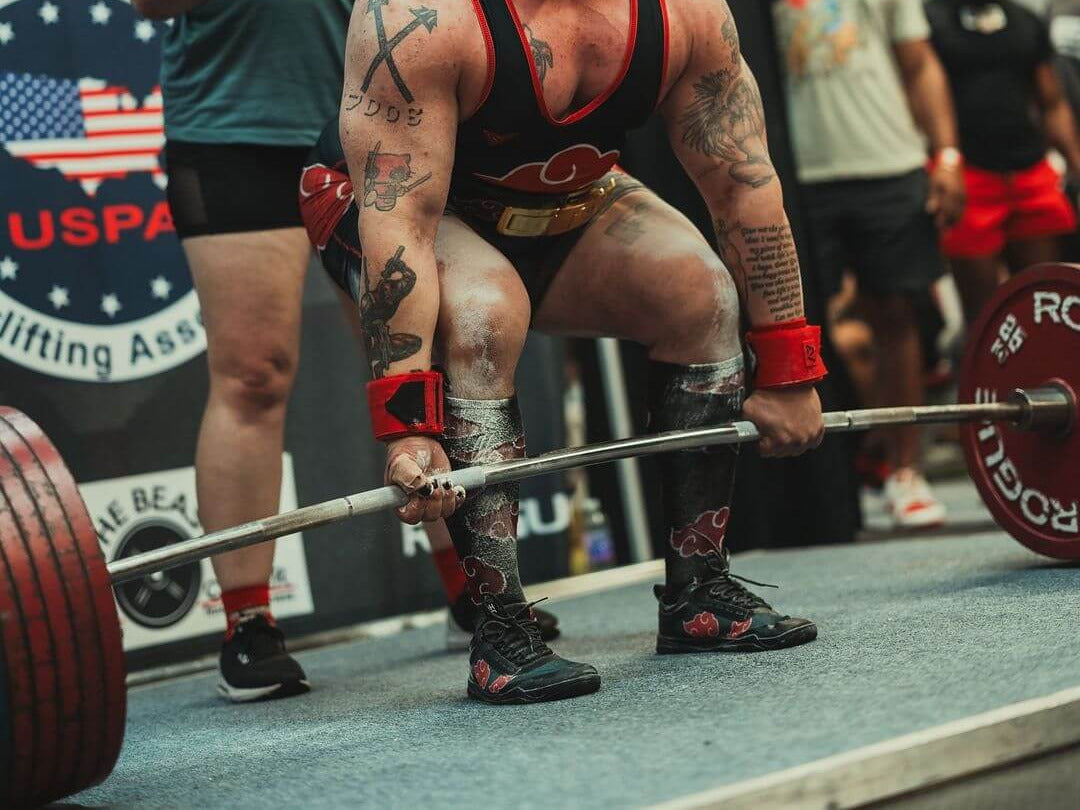
Wear whatever keeps your foot flat, close to the floor and stuck to it. For most lifters that's a deadlift slipper or a firm, flat trainer. Socks alone manage the first two and can lose the third on a smooth floor, and none of the four rulebooks we checked (IPF, USAPL, USPA and IPL) lets you compete in them. The one thing to leave off is the thick, soft sole of a running shoe.
Already know you want a slipper? Our deadlift slippers are thin, flat rubber on a wide base, and they fold flat in a gym bag.
What your feet need in a deadlift
Three things, in this order.
- A sole that doesn't squash. Foam gives under load, and it doesn't give evenly. You end up balancing on it while you're trying to pull.
- As little sole as you can get away with. Whatever sits under your foot is height the bar has to travel.
- Grip. Your feet push out as well as down, most of all in a sumo stance. If they slide, the pull is over.
The research is thinner than the gym talk. One lab study had 30 lifters pull 70% of their max, conventional and sumo, barefoot and in cushioned running shoes. In the shoes the bar traveled further, and the lift took more work and more time. Peak force and bar speed came out the same, and the authors concluded that lifting barefoot doesn't improve performance.
A second study, with 10 men at 60% and 80% of max, found a difference in two of the six things it measured and called the evidence for pulling barefoot limited. We've read that one's abstract, not the full paper. Neither study tested slippers, flat trainers or maximal lifts.
So take a thin, firm sole for what it is. You get a slightly shorter pull and a base that stays put. Neither study showed it adds weight to the bar.
Flat shoes, slippers and socks compared
| Compare | Firm flat trainer | Deadlift slipper | Socks only |
|---|---|---|---|
| Stability | Good with a hard, flat sole. Poor with cushioning or a curved heel. | Thin rubber, nothing to compress. A wide base suits sumo. | Nothing to compress. Nothing holds your foot in place. |
| Traction | Rubber outsole. | Rubber outsole. | Can slide on a smooth or dusty floor. |
| Fit | Laces lock the midfoot. | Snug like a sock, strapped over the instep. Sized by foot length. | Nothing to get wrong. |
| At your gym | Fine anywhere. | Usually fine. Ask if it counts as a shoe. | Often against house rules. Ask first. |
| At a meet | Allowed if it's an indoor athletic shoe with a flat underside. | Named as allowed by USAPL and the IPF. | Not allowed. Footwear is required. |
A flat trainer you already own is the easy place to start, as long as you can't press your thumb into the sole. A slipper earns its place when you want less sole than any trainer gives you, or more grip than socks.
Gym rules and meet rules are two different things
Your gym's policy is a house rule. Plenty of gyms want shoes on in the weights area whatever a rulebook says, so ask at the desk before you pull in socks.
A meet runs on its federation's rulebook. As of November 2026:
- USAPL: closed-toe indoor athletic shoes, powerlifting boots or deadlift slippers on every lift. The underside has to be flat apart from a heel of up to 5 cm, and socks with a rubber sole don't count (USAPL rulebook, v2026.2).
- IPF: shoes or boots, which covers indoor sports shoes, lifting boots and deadlift slippers. The sole can be no thicker than 5 cm, the underside flat, and the shoe fastened while you're on the platform. Rubber-soled socks are out (IPF rulebook, 2026).
- USPA and IPL: lifting shoes or boots, defined to include sport shoes, gymnastic slippers and any foot covering that covers the whole foot and heel and has an inner sole. No spikes or cleats (USPA rules, March 2025 and IPL rules, May 2025).
All four also require long socks for the deadlift, covering the shin to just below the knee. So the socks go in your bag either way. They don't replace the shoes.
None of the four lets you put chalk or anything sticky on your soles. Water is the one thing allowed, from a spray at the IPF and USAPL or a wet towel at USPA and IPL.
We can't tell you a given shoe will pass at your meet. Officials decide at equipment check, so show them the pair you plan to pull in and ask.
A two-minute check in your warm-up
Do this on the floor you'll pull on, before the bar gets heavy.
- Spread the floor. Take your stance and push your feet apart without moving them. If they slide, you need more grip. Brush the dust off the floor or put rubber under your feet.
- Rock. Shift your weight from heel to toe and from side to side. If the sole squashes or tips, it's too soft to pull in.
- Pull one warm-up set. Your foot shouldn't move inside the shoe or slipper, and your heel shouldn't lift.
- Decide now. Keep what passed for the rest of the session. A top set is the wrong time to change what's on your feet.
What else goes on for a pull
Long socks, if you compete or you're tired of scraped shins. And if your grip gives out before your back and legs do, that isn't a shoe problem. Our guide to lifting straps covers when straps help in training, and why to plan on pulling without them at a meet.
Sources
Rules checked against each federation's published rulebook on 18 November 2026. Editions change, so read the current one before you enter a meet.
- Footwear Affects Conventional and Sumo Deadlift Performance, Valenzuela et al., Sports, 2021 (30 lifters, five repetitions at 70% of max, barefoot against standardized running shoes, both stances)
- Shod vs. barefoot effects on force and power development during a conventional deadlift, Hammer et al., Journal of Strength and Conditioning Research, 2018 (10 men at 60% and 80% of max; abstract only)
- USA Powerlifting Rulebook, Version 2026.2, USA Powerlifting (items 3.9 Socks and 3.10 Footwear)
- 2026 IPF Technical Rulebook (effective March 1, 2026, v3), International Powerlifting Federation (socks, and 3.7 Shoes or boots)
- USPA Technical Rules, March 24, 2025, United States Powerlifting Association (items 3.8 Socks and 3.10 Shoes or Boots)
- IPL Technical Rules, May 10, 2025, International Powerlifting League (items 3.8 Socks and 3.10 Shoes or Boots)