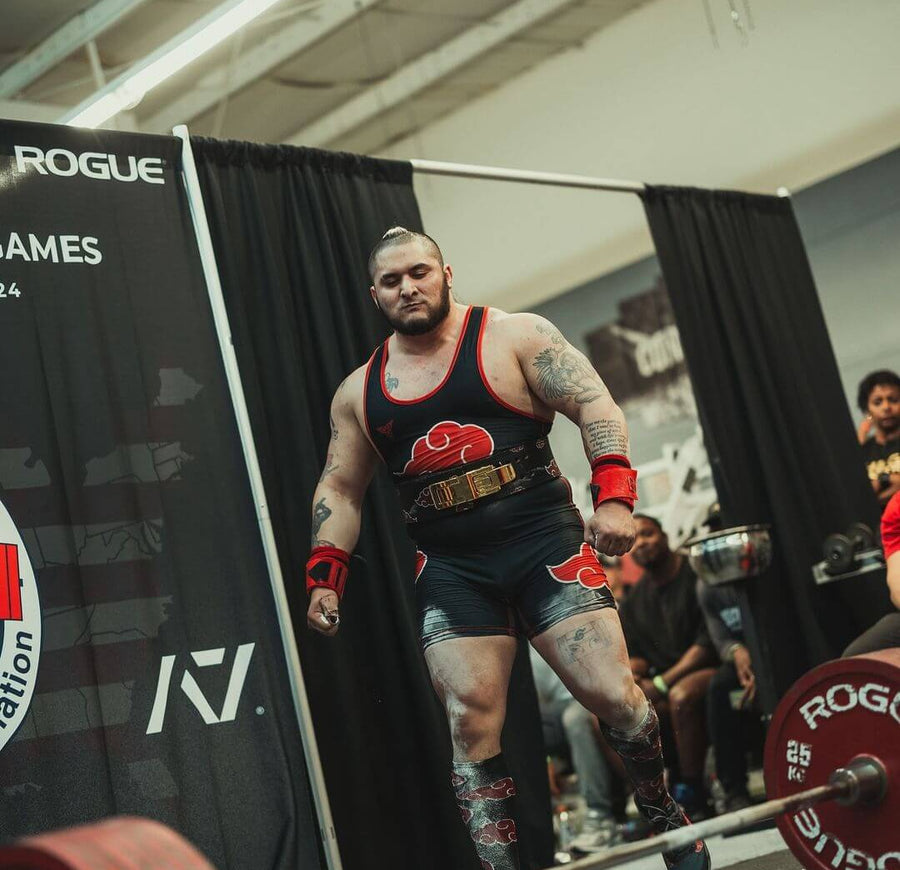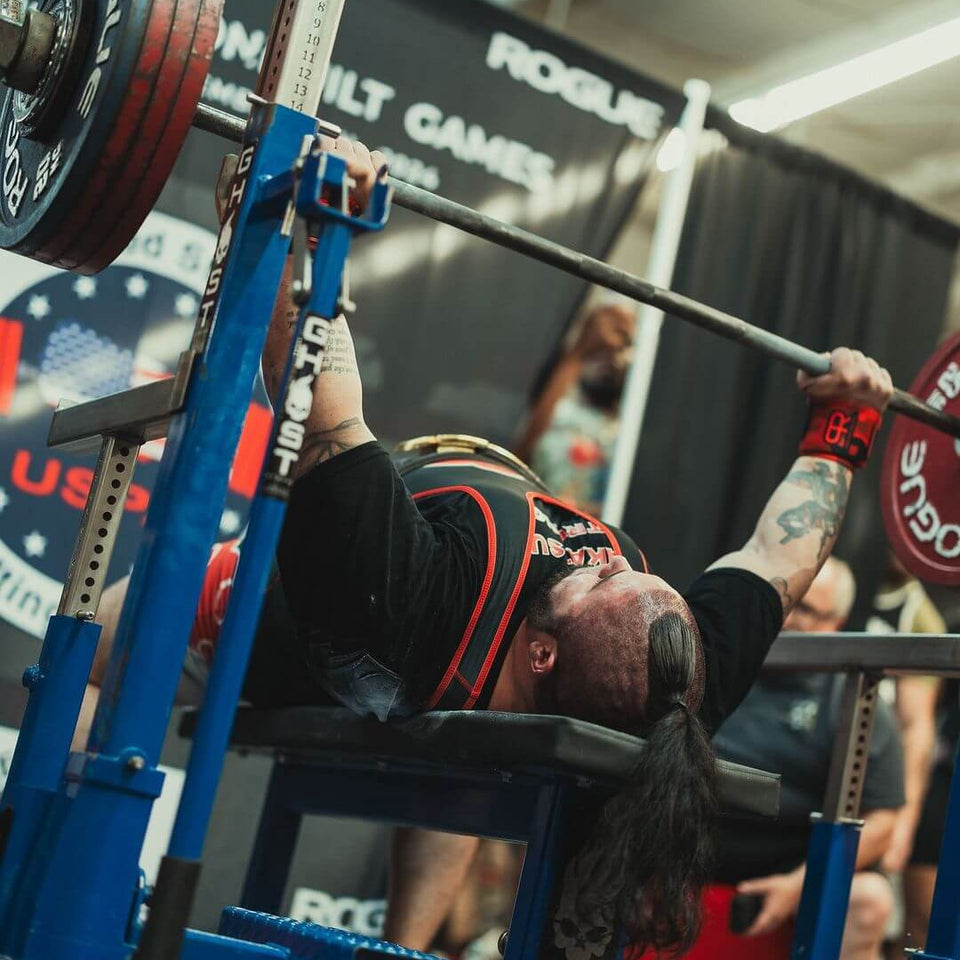
The bar settles into your palms and your wrist folds back. The press feels like it's leaking out the side. That's the job a wrist wrap does, and it's the only job. A small controlled trial of 18 trained lifters found they rated wrapped wrists as more stable than bare ones, and found no change in their bench max, power or bar speed. So wrap for position, not for pounds.
Don't expect wraps to help your grip, either. On pulls, that's a job for straps, which our guide to lifting straps covers. Already know when you want wraps and only need the method? Skip to the wrapping steps.
Quick answers
- Wrap for heavy top sets and singles, when your wrist folds back under the bar. Warm-ups go bare.
- Wrist straight before you wrap. A wrist wrapped bent stays bent.
- Firm enough to hold position, loose enough that your hand keeps its color. Loosen between sets.
- At a meet, thumb out of the loop, and the wrap no wider than 8 cm with no more than 12 cm of coverage.
- Wraps aren't for grip. That's straps.
What wraps do on a press
Wound firmly over the joint, a wrist wrap squeezes the wrist from the outside and resists the hand bending back toward the forearm. That's the direction a heavy bar pushes it as the weight settles into your palm. Stiffer material stretches less, so a stiff wrap restricts that movement more than a flexible one does.
Those 18 lifters, 9 men and 9 women, took part in the only controlled bench trial we found. Each benched with a flexible wrap, a stiff wrap and no wrap, on separate visits. Right after their max attempts, they also rated wrapped wrists as less comfortable than bare ones. Each condition was tested in a single session, and we've read the study's abstract rather than the full paper.
That makes wraps a position tool, so most of this guide covers when and how to put them on. If your wrist hurts, though, have a doctor or physical therapist look at it; wraps aren't a treatment.
When to wrap, and when to leave them off
Save wraps for your heaviest pressing, meaning top sets and singles on the bench and heavy sets of overhead press. Before you add them to those sets, watch for two signs. Either your wrist folds back as the bar settles into your hands, or it loses its stacked position at the bottom of the press. If your wrist holds its position bare, a wrap has nothing to fix yet. That's why warm-ups and light accessory work go without them. The same test works for higher-rep pressing.
Will wrapping weaken your wrists? No study we found has tested that. In practice, saving wraps for heavy sets means your wrists still do most of their work unwrapped.
If your wrists bend back holding the bar on a low-bar squat, the wrapping method below works there too. In a 2023 survey of 70 raw lifters at USAPL and USPA meets, 50 wore wraps for the squat and 62 for the bench. It was a questionnaire handed out at meets in three US regions about what they use, so it can't show what the wraps did for them.
How to wrap your wrist
Lifters wrap in several ways, and none of them is the rule. The sequence below is one common method. It covers the joint and puts your firmest turns over it.
- Anchor the loop. Put your thumb through the loop, or pinch the loop against your palm. In training, either is fine.
- Keep your wrist straight. Hold it in the stacked position you want under the bar, with your hand relaxed. A wrist wrapped bent back stays bent back.
- Start at the crease. The first turn crosses the wrist at the crease where your hand meets your forearm. Its width should cover the joint, with most of it on the forearm side, not down in your palm. Some lifters start with an angled pass across the back of the hand instead. That's fine in training, but at a meet it puts the wrap past the coverage limit toward your hand (see the next section).
- Go up, then come back over the joint. Work a few closely overlapping turns up the forearm, then come back down so the last turns, the ones you pull firmest, finish over the joint. At a meet, every turn has to stay inside the coverage limits in the next section.
- Fasten it flat. Press the hook-and-loop end down along its whole length so the edge can't catch.
- Free your thumb before you step onto the platform. The loop has to be off your thumb during a competition lift. The next section covers what happens if it isn't.
How tight is tight enough?
Firm enough that your wrist doesn't fold back under the bar, and not so tight that your hand changes color. Loosen the wrap at once if you feel tingling, numbness or throbbing, if your fingers turn pale or cold, or if your grip gets weaker. If the feeling doesn't settle once the wrap is loose, leave the wraps off for the rest of the session. Between sets, loosen the wraps or take them off, then rewrap before the next heavy set.
Don't aim for a set number of turns. How many you get depends on the wrap's length and stretch and on the size of your wrist.
What the meet rules allow
The thumb loop comes first. At the IPF, USAPL, USPA and IPL, it can't be over your thumb or fingers during the lift. At a USAPL meet, a loop spotted mid-lift gets you a warning, not a failed lift. USPA and IPL list it as a minor oversight. You finish the lift and get a warning afterward, and a loop that's still on for your next attempt means red lights. Their rules also say a minor violation can cost you the lift, so take the loop off before you walk out.
As of November 2026, all four cap wraps at 1 m (39.4 in) long and 8 cm (3.15 in) wide. Once it's on, a wrap may reach no more than 10 cm (3.9 in) toward the elbow and 2 cm (0.8 in) toward the palm from the center of the wrist joint. That's 12 cm (4.7 in) of coverage at most. USAPL puts the center at the wrist crease nearest your hand.
The rules also call for a single ply of commercially woven elastic (USAPL allows fabric too) covered with polyester, cotton or both. None of the four lets you wear a sweatband with your wraps. At USPA and IPL, no part of the wrap may touch the bar. Check the current editions before you enter. The IPF rulebook (2026), the USAPL rulebook (v2026.2), the USPA rules (March 2025) and the IPL rules (2025).
The IPF accepts supportive wraps only from manufacturers on its Approved List, which applies at every sanctioned meet, from local competitions to world championships. We aren't on that list, so our wraps aren't for IPF-sanctioned meets at any level.
At USAPL, USPA and IPL meets, you may adjust only your belt on the platform, so set your wraps before you walk out. USAPL doesn't limit wraps to a list of brands, but all three federations check your gear around weigh-in.
Our wraps are listed at 8 cm wide, which is the maximum, and we don't publish a measured width. They're also final sale unless they arrive damaged, defective or incorrect (for EU orders, see the 14‑day withdrawal terms in our refund policy). So if you're buying them for a meet, read your federation's rules before you order. Measure them when they arrive, then take them to the gear check. Officials there hold them to every rule, not only the width.
Stiff or flexible?
A stiff wrap takes more effort to put on and lets the wrist move less. A flexible one goes on more easily and lets it move more. The bench trial found no difference in comfort ratings between its flexible and stiff wraps. Its abstract doesn't say whether they differed in stability. In the survey, the researchers classed lifters' wraps by a stretch test, not by what the label said. Of the 62 they classed, 40 were flexible and 22 stiff. Neither result settles the choice for you.
Length doesn't change how stiff a wrap is. On an average wrist, a 60 cm wrap gives a few overlapping turns. It's quicker on and off than a longer wrap, which gives you more turns.
All our wraps are listed at 60 x 8 cm (23.6 x 3.15 in), in one size, with a thumb loop and a hook-and-loop closure. They carry a 6‑month warranty. Two designs also come in Xtra-Stiff versions, Xtra-Stiff Sigil and Xtra-Stiff Dawn. Their listings describe both as built for heavy pressing, and the Sigil listing adds that it isn't a warm-up or volume wrap. We don't publish a stiffness measurement for either kind.
Here's how we'd choose. Our standard wraps are all listed for bench press and overhead work, while the Xtra-Stiff listings are written for heavy pressing. So if these are your first wraps, or you want one pair for all your heavy pressing, start with standard wraps. If you already wrap and want a second pair just for top sets and singles, that's the job the Xtra-Stiff listings describe.
Common questions
Do wrist wraps make you bench more?
Not in the one controlled trial we found. Lifters rated wrapped wrists as more stable, and their max, power and bar speed didn't change. Wraps hold the wrist in position. The weight is still on you.
Should a beginner use wrist wraps?
Not yet. Learn to keep the wrist stacked bare first. Add wraps when your wrist folds back under a heavy bar and won't hold its position without them.
Thumb loop on or off?
On while you wrap, to anchor the start. In training, leave it either way. On a competition platform it has to be off your thumb. If it isn't, a warning is the best you can hope for.
How tight should wrist wraps be?
Firm enough that your wrist doesn't fold back, not so tight that your hand changes color. Tingling, numbness or a weaker grip means loosen them now. Loosen or remove them between sets.
Can I use wrist wraps for squats?
Yes, if your wrists bend back holding the bar on a low-bar squat. Same method. In a survey of 70 raw lifters at USAPL and USPA meets, 50 wore wraps for the squat.
Ready to pick a pair? Choose standard or Xtra-Stiff wraps in our powerlifting wrist wraps collection.
Sources
- Wrist Wraps Do Not Affect Barbell Bench Press Muscular Strength, Power, or Endurance in Resistance-Trained Men and Women, Harris et al., Journal of Strength and Conditioning Research, 2024 (bench max, power, bar speed, stability and comfort with a flexible wrap, a stiff wrap and no wrap; abstract read)
- A Cross-Sectional Examination of Wrist Wrap Use Prevalence and Characterization for Ergogenic Purposes in Actively Competing Powerlifters, Harris et al., International Journal of Strength and Conditioning, 2023 (how many raw competitors wrap for the bench and squat; how many of their wraps a stretch test classed as flexible or stiff)
- Effect of Wrist Wrap in Handgrip Strength in CrossFit, Takemura et al., Acta Ortopédica Brasileira, 2023 (a tight wrap didn't change handgrip strength or grip endurance)
- 2026 IPF Technical Rulebook (effective March 1, 2026, v3), International Powerlifting Federation (size, coverage, thumb loop, material, sweatband and listed-manufacturer rules)
- Approved list of personal apparel and equipment, 2023 to 2026 (V3), International Powerlifting Federation (applies from local meets to world championships; Akinci isn't listed)
- USA Powerlifting Rulebook, Version 2026.2, USA Powerlifting (size, material, coverage measured from the distal wrist crease, sweatbands, thumb-loop warning, equipment check, platform adjustments, no brand list for wraps)
- USPA Technical Rules, March 24, 2025, United States Powerlifting Association (size, material, coverage, sweatbands, bar contact, minor oversight, weigh-in inspection, platform adjustments)
- IPL Technical Rules, May 10, 2025 (V2), International Powerlifting League (size, material, coverage, sweatbands, bar contact, minor oversight, weigh-in inspection, platform adjustments)
- How to Use Lifting Straps, Akinci Strength (straps for grip on pulls)
- Wrist Wraps Collection, Akinci Strength (the wraps we sell; each wrap's product page lists the 60 x 8 cm size, thumb loop and closure, and shows the 6-month warranty)
- Xtra-Stiff Sigil - Wrist Wraps, Akinci Strength (listed size, closure and 6-month warranty; listed for heavy sets, not warm-ups or volume work; final sale except items that arrive damaged, defective or incorrect, with the EU 14-day withdrawal terms in the refund policy)
- Xtra-Stiff Dawn - Wrist Wraps, Akinci Strength (listed size, closure and 6-month warranty; listed for heavy pressing; same returns terms as the Sigil page)
Sources accessed October 12, 2026. Links, rulebooks, studies and product listings re-checked November 18, 2026.