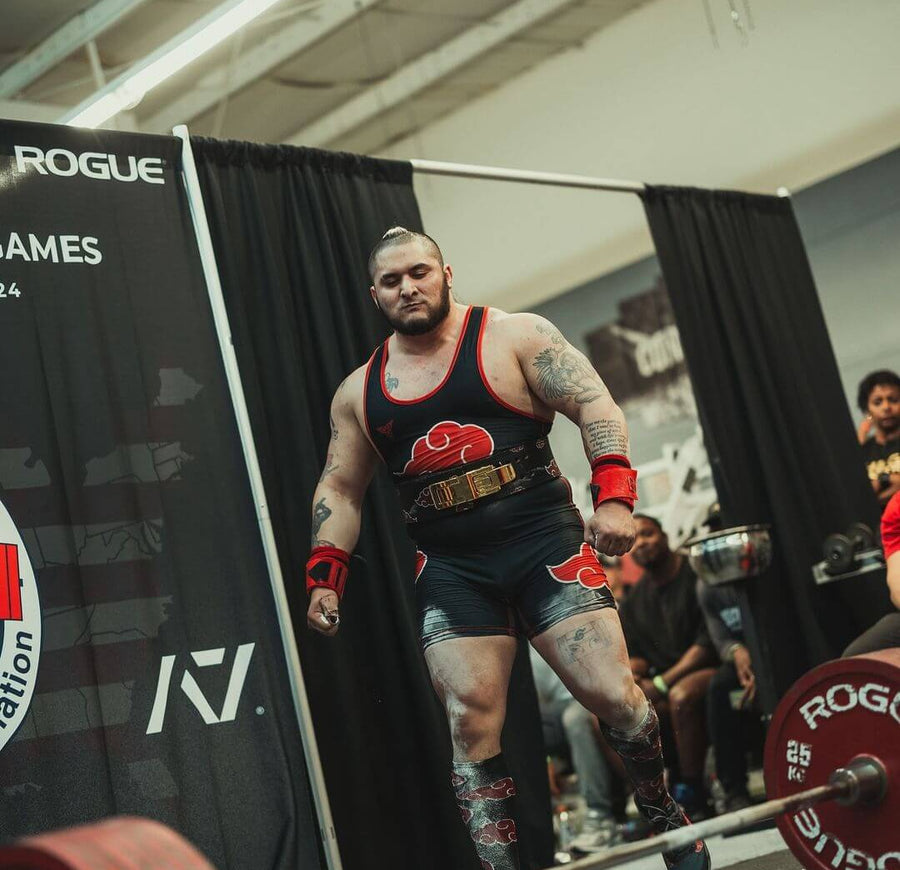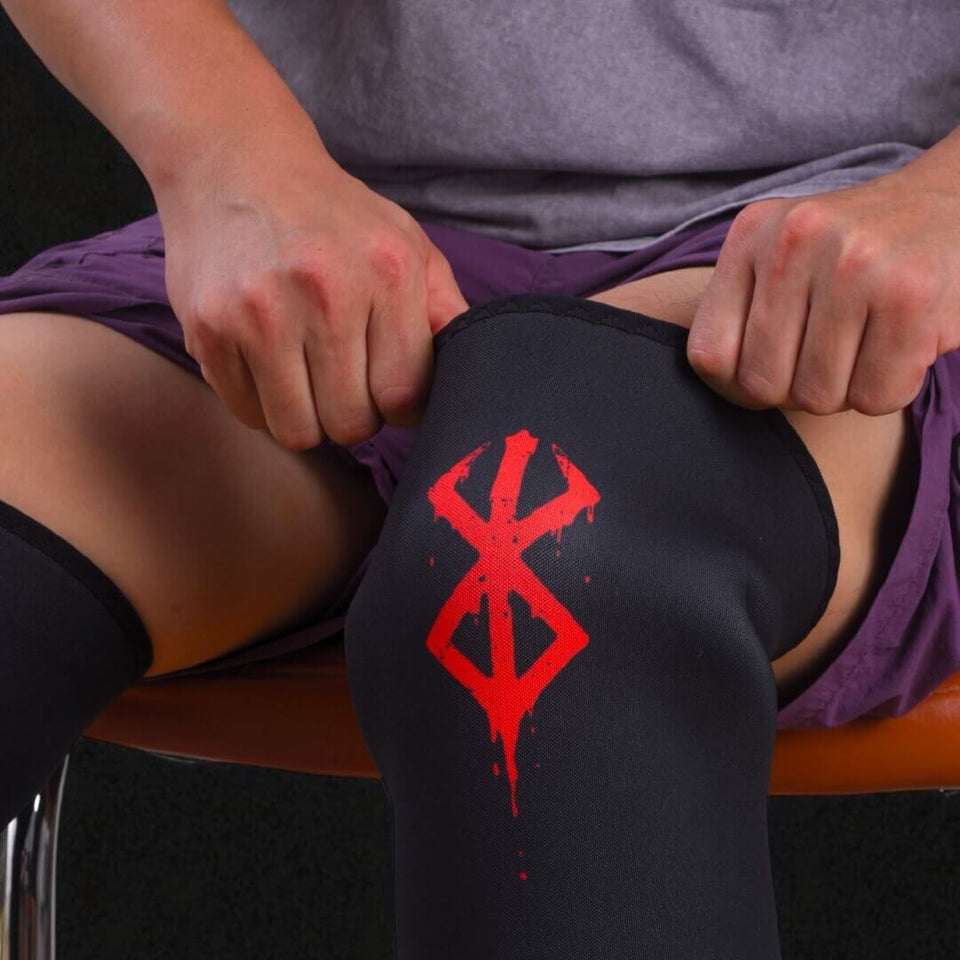
You bought the stiff pair for one feeling. The knee packed tight under a heavy single, nothing moving that shouldn't. Then you fought them on over a sweaty shin, warmed up in them, and by the top set they were hot and you were sick of them. That's the stiff sleeve problem in one session.
The fix is simple. Put stiff knee sleeves on once, just before the heavy part of your squat session, and leave them on until the heavy sets are done. The extra compression is the reason to own a pair. It also costs you time getting them on, heat over a long session and some comfort at the bottom of the squat. Those costs are why a stiff pair belongs on your heaviest sets and almost nowhere else.
Still choosing between firm and stiff, or need a size? Start with our 7mm knee sleeve guide. This one covers where a stiff pair fits in your training and how to pick among ours.
Quick answers
- Warm up bare or in firm sleeves. Change into the stiff pair just before your top sets, before you're soaked.
- Keep them on through the heavy sets, then take them off for back-off and volume work.
- Expect a harder pull-on, more heat and less comfort at depth. That's the trade for the compression.
- A stiffer sleeve isn't a guaranteed extra kilo. The research is small and mixed.
- Competing? Our sleeves aren't for IPF meets. Check the length rule before you pick a pair.
When they go on, and when they come off
On a heavy squat day, warm up bare or in firm sleeves, whichever you prefer. A 2025 survey of 225 knee sleeve users, mostly in the UK and across all sleeve types, found about half of those who train in sleeves warm up in them. Almost 9 in 10 wear them for working sets. The survey recorded volunteers' habits, so it can't tell you which warm-up works better.
Change into the stiff pair as you move to your heavy sets, meaning top sets, singles, heavy doubles or triples. Do it before you're soaked. Lifters report that sleeves are harder to work up over sweaty skin, and a stiff pair is harder to pull on to begin with. Keep them on through your heavy sets, then do back-off sets and volume work in firm sleeves or none.
Meet-rehearsal days are the exception. If you'll compete in the stiff pair, warm up in it too, so the day runs the way it will on the platform. It's practice advice, and we haven't seen a study test it.
Across a week, the stiff pair comes out on heavy squat days and meet-rehearsal days, and through a peaking block, when most squat days are heavy. Lighter and higher-rep days go to firm sleeves or bare knees. A two-pair setup, firm for warm-ups and volume and stiff for heavy sets, avoids most of the costs below.
What the squeeze costs you
Time between sets
Stiff sleeves take longer to get on than firm ones, especially the first few times you pull them on. The method is the same for both, and it's in our guide to getting sleeves on and off. The extra effort is the reason for a single changeover in the plan above.
Heat over a long session
Neoprene holds heat against the skin. When 24 college athletes cycled with and without a neoprene thigh sleeve, skin under it ran 3.1 °C (5.6 °F) warmer than bare skin during the hardest cycling bout. The sleeve didn't change muscle temperature during exercise, though the muscle under it averaged 0.5 °C (0.9 °F) warmer over the 30 minutes afterward.
That was a thigh sleeve on a bike, not a knee sleeve under a bar. The 2025 survey's authors note that no research has looked at heat under knee sleeves. The roughly 3 in 10 respondents who named warmth as a benefit were reporting a feeling.
In a hot gym or a long session, there are two ways to shed some of that heat. Once your heavy squats are done, take the sleeves off. Sliding them down off the knee between sets also helps, but then every set starts with working stiff neoprene back up over a sweaty knee. If your foot goes numb or tingles at any point, take them off at once and check the fit.
Comfort at depth
One hands-on review of a very stiff sleeve from another brand found the rigid neoprene made depth hard to hold comfortably without a fair amount of weight on the bar. The tester suggested keeping the pair mainly for heavier sets. He also found it restricted mobility in some power movements and came close to limiting his setup for cleans. It's one tester's account of one sleeve, and it fits the plan above.
Don't count on the tightness easing, either. The product pages for our firm sleeves say they break in after a few sessions, and our stiff pairs' pages make no such claim.
Does stiffer mean stronger? What the research says
The two studies we found that compared denser and less dense sleeves come from one research group. In one small trial, 19 trained men's squat 1‑rep max averaged 158.7 kg in high-density neoprene sleeves and 153.2 kg in low-density ones, a 5.45 kg (12 lb) difference. They knew which pair they had on, and the paper doesn't name the sleeves or measure their stiffness.
The second study compared high- and low-density sleeves in 15 men in the same city over the same months. It estimated force, velocity and power from squats at rising loads and found no significant differences. Its authors note it was too small to pick up a small or moderate effect. The two may also share participants, so they can't be read as two separate tests.
A 2021 study asked a different question, sleeve or no sleeve, and shows how much lifters vary. Its 15 trained men and women squatted with a regular 7mm sleeve and without one. In sleeves, 6 lifted more, 3 lifted less and 6 lifted the same, and the 2.3 kg (5 lb) rise in the group average wasn't statistically significant. Another lifter's jump in sleeves tells you little about what you'll get.
Bouncing out of the bottom wasn't allowed, so the study doesn't test rebound. About 3 in 10 of the survey's respondents named rebound as a benefit, and we found no study that measured it.
None of these studies tested our sleeves. Density is the variable they point to. Put a stiff pair on for the sets where you want the most compression, and judge it by how those sets feel.
What stiff sleeves can't do
There's no good evidence that knee sleeves, stiff or firm, prevent injury, and a stiffer pair can't be counted on for extra kilos or for rebound. Sleeves don't treat knee pain, repair a joint or replace training and a medical assessment. If knee pain keeps coming back, get it seen by a doctor or physical therapist.
Picking your stiff pair
Our stiff collection holds two lines. The PRO line (ElitePRO, ShadowPRO and DragonPRO) and three Xtra-Stiff designs. The listings label their compression differently, "Stiff / Dense," "Extreme" or "Xtra-stiff," but those are listing words, not test results, so we don't rank the six.
Choose by size range, cut and design instead. XS comes only in the Xtra-Stiff line, so if your knee is small, measure for your size before you pick a line. Whatever the line, buy the size your measurement gives you. The same guide explains why we advise against sizing down for extra squeeze.
DragonPRO is listed as a taller, conical cut with more coverage above and below the knee, and its listing includes a drawstring storage bag. If you compete, check its length against the competition rules for knee sleeves.
Care and warranty won't decide it. Every stiff pair's care panel says to clean them with a damp cloth or soft brush, and every one carries a 12‑month warranty.
Firm is the better buy if most of your leg work is high-rep or machine work. If you cool off by sliding your sleeves down between sets, a firm pair is easier to pull back up. It also suits squat days that include cleans or other fast, deep lifts. You'll find the firm pairs in our 7mm knee sleeves collection; they're the ones without PRO or Xtra-Stiff in the name.
Common questions
Should I warm up in stiff sleeves?
Only on meet-rehearsal days, so the day runs the way it will on the platform. Otherwise warm up bare or in firm sleeves and change into the stiff pair for the heavy sets.
Do stiff sleeves break in?
Don't count on it. The product pages for our firm sleeves say they break in after a few sessions. Our stiff pairs' pages make no such claim.
Why are mine so hard to get on?
Stiff sleeves take more effort than firm ones, especially the first few times. The method is in our guide to getting sleeves on and off. If a sleeve won't go on without talc or a plastic bag, it's probably too small.
Will I squat more in stiff sleeves?
Maybe, and not by much. One small trial found a 5.45 kg difference between high- and low-density sleeves. Another found no difference, and a third found lifters split three ways in sleeves against none. Judge yours by how your heavy sets feel.
Can I compete in them?
Not at IPF-sanctioned meets. We aren't on the IPF Approved List. For USAPL, USPA and IPL, all sleeves are capped at 7mm thick and 30 cm long, so measure your pair, especially the taller DragonPRO. The rules are here.
Ready to pick a pair? Compare size ranges, cuts and designs across the PRO and Xtra-Stiff pairs in our stiff knee sleeves collection.
Sources
- Comparison of high-density and low-density neoprene knee sleeves on back squat and CMJ performance, Leschot Gatica et al., Retos, 2025 (19 men, squat 1-rep max in high-density against low-density sleeves; unblinded)
- Effects of knee sleeve density on theoretical neuromuscular capacities derived from the force-velocity-power profile in the back squat, Leschot-Gatica et al., Journal of Functional Morphology and Kinesiology, 2026 (15 men, no significant differences in estimated force, velocity or power; underpowered by its authors' own analysis)
- Wearing knee sleeves during back squats does not improve mass lifted or affect knee biomechanics, Bennett et al., Human Movement, 2021 (individual responses to a 7mm sleeve against no sleeve; no significant change in the average)
- Knee sleeve practices and beliefs in recreational and competitive strength sport athletes: an international cross-sectional survey, Bell et al., International Journal of Sports Science and Coaching, 2025 (when lifters wear sleeves; warmth and rebound as reported benefits; no research on heat under knee sleeves)
- Neoprene thigh sleeves and muscle cooling after exercise, Miller et al., Journal of Athletic Training, 2005 (skin and muscle temperature under neoprene during and after cycling)
- Slingshot STrong Knee Sleeves Review, BarBend (one tester's experience of a very stiff sleeve: depth at lighter weights, setting up for cleans, mobility in power movements)
- DragonPRO - 7mm Knee Sleeves, Akinci Strength (conical cut, storage bag, care panel, warranty)
- Stiff Knee Sleeves, Akinci Strength (the collection of six stiff pairs, with their size ranges; each product page carries its compression label, care panel and warranty)
- 7mm Knee Sleeves, Akinci Strength (the collection of all 11 pairs, firm and stiff)
- 7mm Knee Sleeves: Stiffness & Fit, Akinci Strength (firm or stiff, measuring and sizing, putting sleeves on, fit, competition rules)
Sources accessed October 12, 2026. Links, studies, rulebooks and product listings re-checked November 18, 2026.